In the 2025 THPTQG exam (Vietnam's national high school graduation exam), the
Math paper included a rather novel number-filling problem that surprised many
students. This problem also hides quite a bit of interesting structure - in
this post, we'll model it together to see exactly where that interest lies.
The original problem asks for the probability that a random arrangement
satisfies an arithmetic-progression requirement. In this post, however, we
only care about finding every arrangement that satisfies the requirement.
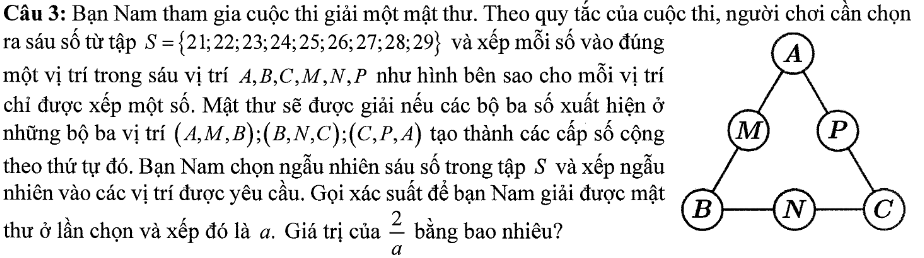
So the problem can be restated in general form as follows: choose 2n numbers
out of the n2 numbers {1,2,3,...,n2} and arrange them into a
sequence at positions {0,1,...,n−1} such that every triple of numbers
at positions (2k,2k+1,2k+2) for ∀k∈{0,1,...,n−2}
forms an arithmetic progression, and the triple at positions (2n−2,2n−1,0) also forms an arithmetic progression.
The model built above only gives us one solution. To find all remaining
solutions, we use the following simple logic
BEGIN THPTQG2025 initialize model M; solve M; S := solution of M; WHILE (M is not infeasible) add a constraint so that solution S no longer satisfies the model; solve M; S := solution of M; END Return S;END
Where the constraint used to exclude a solution is as follows
(i,j)∈S∑x(i,j)≤2n−1
Where S is a solution of the model, of the form {(i,j)∣i∈{0,1,...,n−1};j∈{1,2,3,...,n2};position i is filled with number j}
 TungTT