TungTT
Series: Modeling logic puzzles
Phần: 6 / 91. Introduction
Slitherlink is a logic puzzle with the following rules:
- Connect the dots on a grid, horizontally or vertically, to form a single closed loop, without crossings or branches
- Some cells, each formed by 4 dots on the grid, are pre-filled with a number smaller than 4, indicating how many of that cell's edges must be part of the loop (empty cells may have any number of surrounding edges)
Note: an edge is defined as a connection between 2 adjacent dots
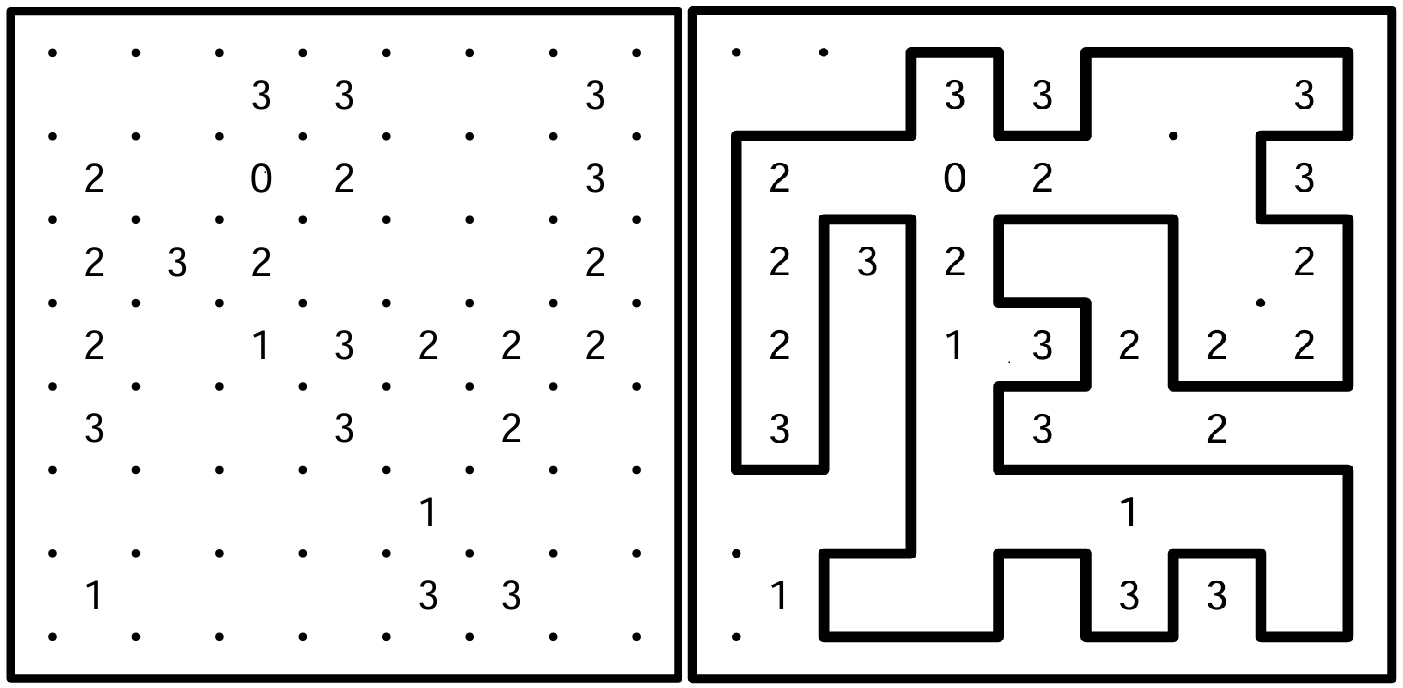
Below is an example of a 7×7 Slitherlink puzzle and its solution
2. Modeling puzzle
- is the number of rows in the grid
- is the number of columns in the grid
- : the set of cells that have a number inside
- : the number filled inside cell
- : the horizontal edges connected to point
- : the vertical edges connected to point
2.1. Decision variables
To solve this problem we need to define a variable for each edge on the grid and each point on the grid, as follows
- For each horizontal edge on the grid (), define variable such that
- For each vertical edge on the grid (), define variable such that
- For each point on the grid (), define variable such that
2.2. Constraints
- The number of edges surrounding a cell equals the number filled in that cell (except for empty cells)
-
The points must connect into a single closed loop, without crossings or branches.
Modeling this condition directly is far from easy, so here we model part of the condition and use an algorithm described in section 2.4 to solve the rest. Specifically, we model the condition: "the points must connect into some number of disjoint, closed, non-crossing, non-branching loops".
2.3. Objective function
This problem does not have an objective function, as we are not aiming to minimize or maximize any value. Our goal is simply to find a feasible solution. Technically, when programming, we can set the objective function to a constant (I often choose 0).
2.4. Solving the problem
Solving the model above gives us a solution that satisfies almost every condition of the problem, except that instead of a single loop, we may end up with several disjoint loops. To fix this, we use the following algorithm:
BEGIN Slitherlink
    initialize model M;
    solve M;
    S := solution of M;
    WHILE (S still contains more than 1 loop)
        add constraints to cut every loop in S;
        solve M;
        S := solution of M;
    END
    Return S;
END
The constraint used to cut a loop is modeled as follows
Where is the set of all loops obtained after one solve, is the set of all horizontal edges in loop , and is the set of all vertical edges in loop .
3. Conclusion
The highlight of this puzzle is the loop-cutting algorithm - a fun idea for dealing with problems that are hard to model directly: solve several approximate models one after another until you land on the correct solution.
For more Slitherlink puzzles and variations, please refer to Krazydad. The Python code for Slitherlink modeling is available at Tung-hehe.
Happy modeling!